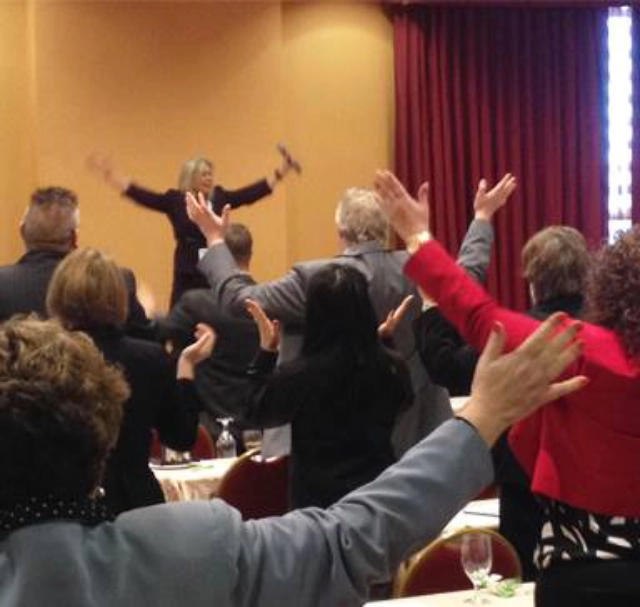
At the end of my keynote, I ask the audience to stand up and find a partner.
It’s what I call my A/B partner activity.
For 30 seconds partner A tells B things they’re good at – what they do well – what they’re proud of.
Then for 15 seconds, partner B celebrates them. Reaffirms how great they are at the things they’ve just shared.
That’s it.
Simple.
No props.
No complicated instructions.
No production tricks.
Just two humans intentionally building each other up.
And every single time — whether it’s a group of ten or a ballroom of a thousand — something shifts.
You can feel it.
Voices get louder.
Shoulders relax.
People laugh.
I’ve seen coworkers hug like long-lost friends.
I’ve seen tears. (lots of tears….)
I’ve seen the kind of embraces that would probably make HR a little nervous — but are full of genuine human connection.
When we finish, I always ask:
“Can you feel how the energy in this room has shifted?”
And they shout back, “Yes!”
They clap.
They feel it.
The vibration in the room is different.
Not because of me.
Because of them.
Energy Is Collective
We often talk about conference engagement as if it’s about content.
Better slides.
Better speakers.
Better breakout topics.
But energy isn’t primarily intellectual.
It’s relational.
When people feel seen, celebrated, and connected, their nervous systems change.
They sit up differently.
They participate differently.
They listen differently.
And that shift doesn’t just feel good — it affects outcomes.
Engaged attendees:
• Retain more.
• Participate more.
• Network more.
• Return the following year.
Energy is not fluff.
It’s fuel.
And when that fuel is directed toward connection, it becomes one of the most powerful drivers of conference happiness.
Why the Opening Keynote of a Conference Matters
I intentionally place that A/B activity toward the end of my keynote.
And it’s especially effective when I am the opening keynote for a conference.
Because I’ve watched what happens when you kick off a conference with elevated energy right out of the gate.
The room feels unified.
Conversations start faster.
People are more open.
There’s momentum.
And that momentum carries.
The networking feels easier.
The breakout sessions feel livelier.
The hallway conversations feel warmer.
High energy at the beginning doesn’t fade.
It compounds.
The emotional tone of an event is often set in the first few hours.
When that tone is positive and connected, it creates the conditions for happier teams long after the event ends.
Designing the Emotional Arc of an Event
Great conferences don’t just manage logistics.
They design an experience.
They ask:
What do we want people to feel?
When do we want them to connect?
How do we intentionally elevate energy?
Energy can be designed.
Connection can be facilitated.
Belonging can be engineered into the agenda.
And when it is, results follow.
Because when people feel happy and connected, they engage differently — and engagement drives results.
Because when people feel something together, they remember it together.
And when they remember it, they come back.
Author Bio
Kim Hodous, CSP®, is a keynote speaker who helps associations and organizations build happier, healthier work cultures through practical habits rooted in research. Known for her thoughtful customization, high-energy delivery, and engaging storytelling, Kim blends energy, habits, and connection to help teams increase engagement, reduce burnout, and drive better results.
Planning a conference? Learn more about bringing Kim to your next event.
Want to see the A/B partner activity in action?